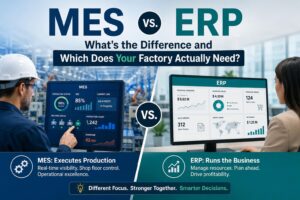

If you run a factory and someone mentions "MES," you have probably nodded along while quietly wondering what it actually does — and whether you need one.
Read More
If you run a factory and someone mentions "MES," you have probably nodded along while quietly wondering what it actually does — and whether you need one.
Read More
What if the next generation of computing infrastructure looked less like a server rack and more like an aquarium?
Read More
IP cameras. PLCs. HVAC controllers. Access panels. Smart meters. The modern enterprise is full of connected devices that were never designed with security in mind — and most organizations have no idea what those devices are doing on the network.
Read More
For factory owners who invested millions, waited years, and still don’t have a system that works. You didn’t fail. The project failed you.
Read More
Most custom ERP projects don’t fail because the platform was too weak. They fail because the team used the wrong layer of it — and discovered the ceiling six months in, after the budget was spent and the business had already reshaped itself around the half-built system.
Read More
There’s a moment in almost every project kickoff where someone proposes the framework. The big one. The one with the conference, the certification track, the "enterprise" tier, and the slide that promises it does everything. And almost every time, choosing it is the first quiet mistake of the project.
Read More
Your best Tier 1 analyst just gave notice. She’s been with you 18 months. She didn’t quit because of the hours. She didn’t quit because of the pay. She quit because for 18 months she has triaged the same five false-positive alerts, in the same five tools that don’t talk to each other, against the […]
Read More
There’s a sentence we hear at the kickoff of every ERP integration rescue: "It worked perfectly in UAT."
Read More
There’s a graveyard somewhere in every enterprise IT department. It’s full of demos that wowed a steering committee in 2024, RAG prototypes that beat ChatGPT on three cherry-picked questions, and copilots that looked unstoppable in a sandbox. Then someone asked the hard question — can we put this in front of 4,000 employees, integrated with […]
Read More
If you’re running ERPNext across multiple Asian factory operations — say a manufacturing plant in India, a Southeast Asian satellite (Thailand, Vietnam, Indonesia), and an export-oriented Chinese subsidiary — you’ve probably noticed the same pattern in three different forms. ERPNext handles the manufacturing operations beautifully. The Manufacturing module, the BOM/work order/subcontracting flow, the multi-warehouse stock […]
Read More
If you run Odoo across multiple Asian markets — say, a manufacturing operation in Thailand, a sales subsidiary in Japan, and a procurement office in China — you’ve probably discovered the same thing in three different ways. The standard invoice digitization feature works beautifully on the AWS bills and the European supplier invoices. It struggles, […]
Read More
A field guide to measurement data integration for Singapore precision manufacturers, medical device makers, aerospace component suppliers, and semiconductor back-end shops.
Read More
Enterprise ERP integration is a solved problem — at least, that’s what your SI vendor will tell you. The reality inside tier-2 and tier-3 manufacturing plants is very different: brittle point-to-point connectors, hand-rolled ABAP scripts, and decades-old middleware that breaks every time a vendor pushes a schema update. The data exists. The systems exist. The […]
Read More
Most engineering blogs are written for an audience that already exists. This one is written for the engineer, founder, or operations leader who is about to deal with a problem — and is trying to find someone who has actually shipped a working system, not just summarized a vendor whitepaper.
Read More
The data source nobody wants to talk about Walk into the General Affairs department of a Japanese, Thai, or Chinese factory and ask where last month’s electricity consumption data is. You will not be directed to a system. You will be directed to a folder — physical or digital — containing PDFs from the local […]
Read More
The first time a Japanese, Thai, or Chinese conglomerate’s CFO sees a Big 4 CSRD readiness proposal, the reaction is some variant of disbelief. €2–4M for the first year. €400–900K ongoing. Hourly rates that translate to JPY 60,000–100,000, RMB 3,000–5,000, or THB 13,000–22,000 per hour. The proposal arrives with a Gantt chart, a stakeholder map, […]
Read More
The €5M quote and the wrong line item A pattern we keep seeing. A Japanese, Korean, or Thai conglomerate gets the letter — or rather, the internal memo — confirming that one of their EU subsidiaries crosses the CSRD threshold. Net turnover above €50M, more than 250 employees, listed or large enough that the Omnibus […]
Read More
Every vendor with a security product has bolted "AI" onto the marketing page in the last eighteen months. Most of it is rebranded ML classification: anomaly detection that already existed, dressed in 2024 clothes. Where it gets genuinely interesting — and where most teams fail — is when you actually wire a tool-using LLM agent […]
Read More
Walk into any mid-sized accounting firm in Bangkok and you’ll see the same thing. Three monitors. One has FlowAccount open — logged in as the client. Another has Excel — the master tracker, color-coded by partner, deadline, and filing type. The third has LINE — twelve group chats, one per client, full of photographed receipts, […]
Read More
How much RAM, VRAM, and GPU do you actually need? An engineer’s guide to picking hardware for running LLMs locally — without overspending, and without surprises.
Read More