
Articles

How to Predict Metal Prices for Recycling Businesses (Without Becoming a Trader)
Industry Thinking

How to Predict Metal Prices for Recycling Businesses (Without Becoming a Trader)

Introduction Many recycling business owners ask the same question: “How can I predict copper or steel prices so I don’t buy at the wrong time?” The honest answer is this: You don’t need perfect prediction. You need better decisions than yesterday. This article explains a practical, business-oriented approach to predicting metal prices—designed specifically for recycling […]

Read More
Who Moved My Cheese?
Dev

Who Moved My Cheese?

A Survival Guide for Software Developers in the AI Era The book Who Moved My Cheese? looks simple—almost childish. But its lesson is brutally relevant for software developers living through the AI era. AI didn’t just improve our tools. It moved the cheese.

Read More
Designing Tailored E-Commerce Systems
Dev E-Commerce

Designing Tailored E-Commerce Systems

Why Competing with Shopee or Amazon Is the Wrong Goal When organizations consider building an e-commerce system, the first concern is almost always competition with large platforms such as Shopee, Lazada, Amazon, or TikTok Shop. These platforms dominate through capital, traffic, logistics subsidies, and aggressive marketing. Trying to compete with them directly is not a […]

Read More
Anti‑Patterns Where AI Breaks Systems
AI

Anti‑Patterns Where AI Breaks Systems

Artificial Intelligence promises speed, automation, and insight. Yet in real-world software projects—especially enterprise, GovTech, ERP, and industrial systems—AI often breaks systems instead of improving them. This usually does not happen because AI models are "bad", but because they are applied with the wrong mental model. This article documents common anti‑patterns we see when AI is […]

Read More
Why We Don’t Just Build Software — We Make Systems Work
Dev ERP

Why We Don’t Just Build Software — We Make Systems Work

In many projects, the problem is not that software doesn’t exist. The problem is that nothing works together. Orders are correct in one system but wrong in another. Data is duplicated, delayed, or lost. People fall back to Excel, LINE, and manual work. This is where our real strength lies.

Read More
Useful Wazuh Admin Prompt Packs
AI Security

Useful Wazuh Admin Prompt Packs

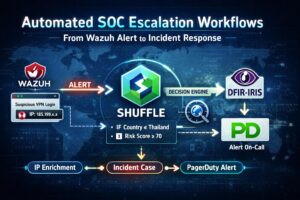
How Security Teams Use AI to Manage, Tune, and Scale Wazuh Faster Why Wazuh Administration Is Harder Than It Looks Wazuh is powerful, open-source, and flexible—but that flexibility comes with operational cost. Many Wazuh administrators struggle with: Writing correct detection rules Tuning alerts without losing visibility Mapping alerts to real business risk Explaining findings to […]

Read More
Why Replacing Legacy Systems Fails in Government (And What Works Instead)
City Dev

Why Replacing Legacy Systems Fails in Government (And What Works Instead)

Government agencies around the world share a familiar frustration: critical systems built decades ago are still running core services, yet no longer fit today’s digital expectations. When the pain becomes too visible, the most common reaction is also the most dangerous one: “Let’s replace the legacy system.” History shows that this approach fails far more […]

Read More
Vertical AI Use Cases Every Local Government Actually Needs
AI City

Vertical AI Use Cases Every Local Government Actually Needs

Local governments around the world are under pressure to do more with limited budgets, limited staff, and legacy systems. While AI is often presented as a futuristic solution, many public-sector AI projects fail because they focus on technology first instead of government workflows. This is where Vertical AI becomes essential. Vertical AI does not start […]

Read More
Designing Digital Service Delivery for Multi-Department Governments
City Dev

Designing Digital Service Delivery for Multi-Department Governments

Digital service delivery is no longer about building a single website or launching a standalone mobile app. For multi-department governments—such as provinces, prefectures, municipalities, or large ministries—the real challenge lies in coordination, integration, and sustainability across many independent units, each with its own mandates, data, and legacy systems. This article explores how to design digital […]

Read More
The Top 7 Reasons Digital Government Services Fail After Launch
City Dev

The Top 7 Reasons Digital Government Services Fail After Launch

Digital government services often launch with high expectations: improved efficiency, better citizen experience, and reduced operational costs. Yet, many of these systems struggle—or quietly fail—within months after going live. This article explores the seven most common reasons digital government services fail after launch, based on real-world GovTech projects and system integration experience.

Read More
Reference Architecture for Provincial / Municipal Digital Systems
City Dev

Reference Architecture for Provincial / Municipal Digital Systems

Local governments—provinces, municipalities, prefectures, cities—face a unique digital challenge. They must deliver reliable public services over 10–20 year lifecycles, integrate with national systems, survive vendor changes, and operate under tight budgets and procurement constraints. This article presents a practical reference architecture for provincial and municipal digital systems. It is not tied to any product or […]

Read More
A Practical GovTech Architecture: ERP, GIS, Citizen Portal, and Data Platform
City Dev

A Practical GovTech Architecture: ERP, GIS, Citizen Portal, and Data Platform

Local governments are under increasing pressure to deliver better digital services with limited budgets, fragmented legacy systems, and small IT teams. Many GovTech initiatives fail not because of technology choices, but because systems are designed in isolation. This article presents a practical, integration-first GovTech architecture that local governments can realistically implement and evolve over time—without […]

Read More
Why Emergency Systems Must Work Offline First (Lessons from ATAK)
City Network Satellite Security

Why Emergency Systems Must Work Offline First (Lessons from ATAK)

In every major disaster—floods, earthquakes, wildfires, or large-scale accidents—the first thing that fails is often not people, but infrastructure. Power goes down. Mobile networks become congested or unavailable. Internet connectivity becomes unreliable or disappears entirely. Yet many so-called “smart” emergency systems are designed with an assumption that connectivity will always be available. This assumption is […]

Read More
Why Government Software Projects Fail — And How to Prevent It Before Writing Code
Dev

Why Government Software Projects Fail — And How to Prevent It Before Writing Code

Introduction: Failure Is Not a Technology Problem Across the world, local government software projects often fail — not because the technology is too advanced, but because the system was never designed to survive reality. Budgets are spent, systems are delivered, and yet: Officers return to Excel Citizens still queue at counters Data is duplicated across […]

Read More
After the AI Hype: What Always Comes Next (And Why It Matters for Business)
AI

After the AI Hype: What Always Comes Next (And Why It Matters for Business)

Why this article exists Every major technology wave follows the same emotional arc: Excitement → Overpromise → Disappointment → Quiet value creation AI is not special in this regard. What is special is how fast the hype arrived — and how fast organizations are now discovering that intelligence alone does not create value. This article […]

Read More
Why AI in Recycling Fails Without System Integration
AI Industry

Why AI in Recycling Fails Without System Integration

Introduction Many recycling companies are investing in AI technologies with the hope of improving efficiency, yield, and profitability. However, a significant number of these projects fail to deliver real business value. The primary reason is not the AI models themselves—but the lack of proper system integration. This article explains why AI initiatives in recycling often […]

Read More
ISA-95 vs RAMI 4.0: Which One Should You Use (And Why Both Matter)
Industry

ISA-95 vs RAMI 4.0: Which One Should You Use (And Why Both Matter)

When factories begin their digital transformation, one question comes up again and again: Should we design our systems using ISA-95 or RAMI 4.0? The short answer is: this is the wrong question. ISA-95 and RAMI 4.0 are not competitors. They solve different problems at different abstraction levels, and the strongest industrial architectures use both together.

Read More
Why Low‑Code Is Falling Out of Trend (and What Replaced It)
AI Dev

Why Low‑Code Is Falling Out of Trend (and What Replaced It)

For several years, low‑code and no‑code platforms were positioned as the future of software development. The promise was compelling: build applications faster, reduce engineering cost, and allow non‑developers to create real systems. But in 2025, the momentum has clearly slowed. Low‑code is not dead—but it is no longer where innovation is happening. This article explains […]

Read More
The Biggest Product Failures of 2025 — And the Real Reason They Failed
AI Dev

The Biggest Product Failures of 2025 — And the Real Reason They Failed

In 2025, technology did not fail. AI models became stronger. Hardware became faster. Cloud platforms became more mature. Open‑source ecosystems expanded rapidly. And yet, products failed at a historic rate — from AI devices and enterprise platforms to consumer hardware and robotics startups. This article is not a list of “bad products.” It is a […]

Read More