
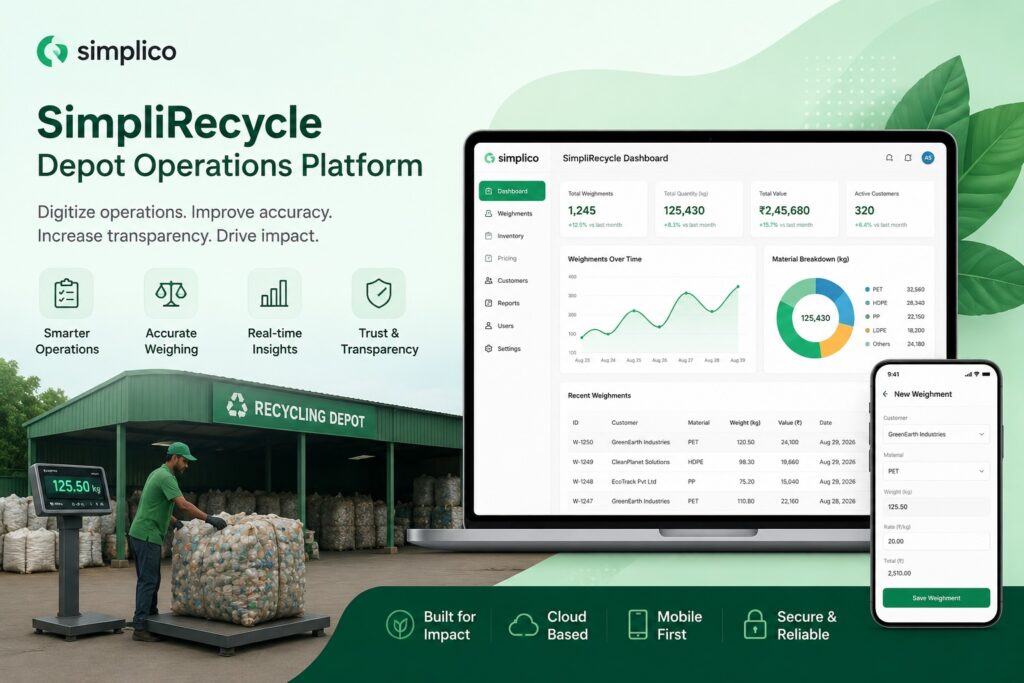
Most scrap recycling depots run on a mix of paper weigh tickets, WhatsApp photos of scale readings, and a spreadsheet someone reconciles at the end of the week. It works, until it doesn’t: a price gets misquoted at the gate, a lot of copper sits in the yard for a month without anyone noticing, or the accountant spends two days at month-end trying to match invoices back to what actually crossed the scale. simpliRecycle, a depot operations platform built by Simplico, is designed to close that gap — tracking material from the moment a supplier’s truck rolls onto the scale to the moment a VAT invoice is paid, in one connected system.
This post walks through what the platform actually does, how the pieces fit together, and why the design choices — mobile-first weighing, price snapshotting, FIFO allocation — matter for depots operating in Thailand and Southeast Asia.
1. The problem simpliRecycle is built around
A scrap depot’s core operational loop is deceptively simple to describe and genuinely hard to run cleanly: buy material from suppliers at a weight- and grade-dependent price, hold it in inventory, sell it to buyers, and invoice correctly with VAT. The difficulty is that each step generates data that the next step depends on — the price locked in at intake has to survive into the invoice weeks later; the grade assigned at the scale has to match what actually ships; and the numbering on lots, orders, and invoices has to never collide, even with multiple weighers working the yard at once.
Spreadsheets and paper tickets don’t enforce any of that. simpliRecycle does, by modeling the whole flow as one pipeline rather than a set of disconnected tools. On the live demo instance, that pipeline is already tracking ten material types priced by grade across fifteen registered suppliers — small numbers, but they’re the same shape a real yard runs at, just before it scales up.
2. The pipeline: six applications, one flow
simpliRecycle is built as six integrated applications that share a single source of truth, so a transaction only has to be entered once and then flows downstream automatically. There’s no event bus and no background signals wiring the stages together — each stage hands off to the next through a plain foreign key, and inventory and reporting don’t own any data of their own; they’re read-only views over what intake, sales, and billing already recorded.
sequenceDiagram
    actor Supplier
    actor Weigher
    participant simpliRecycle as simpliRecycle
    actor Cashier
    actor Buyer
    actor Manager

    Supplier->>Weigher: Truck arrives with material
    Weigher->>simpliRecycle: Record weigh-in (gross/tare, material type)
    simpliRecycle->>simpliRecycle: Assign A/B/C grade + snapshot price
    simpliRecycle-->>Supplier: Live QR mirror shows weigh-in in real time
    simpliRecycle->>simpliRecycle: Post lot to FIFO inventory

    Cashier->>simpliRecycle: Look up supplier balance
    simpliRecycle-->>Cashier: Outstanding payable across invoices
    Cashier->>Supplier: Settle payment

    Buyer->>simpliRecycle: Place sales order
    simpliRecycle->>simpliRecycle: Allocate stock (oldest lot first)
    simpliRecycle->>simpliRecycle: Generate VAT invoice
    simpliRecycle-->>Buyer: Invoice with subtotal + balance

    Manager->>simpliRecycle: Open dashboard
    simpliRecycle-->>Manager: Revenue vs. cost, payable vs. receivable, stock aging
Everything after the weigh-in — grading, pricing, stock posting, invoicing — happens automatically because it was captured correctly at the point of intake. That’s the core design bet: get the weigh-in right, and the rest of the pipeline mostly takes care of itself.
3. What’s actually inside
Supplier weigh-ins with a live QR mirror. Suppliers can watch their own weigh-in happen on their phone in real time via a QR code, rather than taking the depot’s word for the weight and grade after the fact. That single feature removes a surprising amount of the trust friction that slows down yard operations.
A/B/C grading with price snapshotting. Material is classified into grade tiers at intake, and the price for that grade is locked in — snapshotted — at the moment of the transaction. Because commodity and scrap prices move, without a snapshot a price change three weeks later would silently retroactively change what a supplier was supposedly owed. Snapshotting prevents that class of dispute entirely, and every lot detail screen doubles as the permanent record for any weight or price dispute.
FIFO inventory. Stock is allocated oldest-lot-first when a sales order is fulfilled — confirming an order locks and pulls stock automatically, and flags a line the moment it can’t be fully filled. For scrap and recyclables, this isn’t just an accounting convention — the platform surfaces aging-stock alerts for material sitting 22+ days, so a manager knows before a lot has been sitting long enough to be a problem, not after.
Collision-free numbering. Lots, sales orders, and invoices all get unique identifiers even when multiple weighers and cashiers are working simultaneously — a small detail that matters a lot the first time two people try to close a transaction at the same moment.
VAT-aware invoicing. Invoices carry subtotal, VAT, and running balance, with payment tracking across multiple invoices per buyer — built for how Thai and regional tax requirements actually work, not bolted on afterward.
Full audit logging. Every change is logged with a timestamp, which turns "who changed this price" from a guessing game into a lookup.
Role-based access control keeps weighers, cashiers, managers, and admins each working with the parts of the system relevant to them — enforced with a role check on every view, rather than left to a generic permissions system — which is also what makes the next section possible.
4. Built around the roles that actually run a yard
A depot management system lives or dies on whether the person standing at the scale in the sun can use it as fast as they could fill out a paper ticket. simpliRecycle’s role design reflects that:
Weighers get a mobile-optimized screen for on-site buying, with automatic tare subtraction and a minimal set of fields — designed for outdoor use, not a desktop workflow shrunk onto a phone. A single missing-fields prompt lists everything still needed before submit, rather than surfacing one native tooltip at a time, and quick-add lets a weigher register a new truck, worker, or container type without ever leaving the form.
Cashiers get automated FIFO stock pulls, payment tracking across multiple invoices, and numbering that never collides, so reconciling supplier payments doesn’t turn into a manual matching exercise.
Managers get a single dashboard: revenue versus cost, payable versus receivable, and stock aging, on one screen — the three numbers that actually answer "how is the yard doing today."
Admins get full control over suppliers, buyers, pricing tables, and depot settings, plus the ability to clean up a mis-recorded onsite session before it’s ever confirmed — useful the first time someone weighs the wrong truck.
Reports export to CSV for anyone who still needs to hand numbers to an accountant or a spreadsheet — which, realistically, is most depots, at least for now.
5. How it’s built
simpliRecycle runs on a straightforward, well-understood stack: Django 5 and PostgreSQL on the backend, htmx and Alpine.js for interactivity without a heavy frontend framework, Bootstrap 5 and crispy-forms for the UI, WeasyPrint for generating invoice PDFs, and Docker Compose for deployment. It’s a deliberately unglamorous choice of tools — the kind that a small operations team can actually run and maintain without a dedicated platform engineer, which matters more for a depot’s back office than novelty would.
6. Who it’s for
simpliRecycle is aimed at scrap recycling depots, material traders, and recycling yards operating across Thailand and Southeast Asia — businesses where the core transaction (buy graded material by weight, hold it, sell it, invoice it) repeats dozens or hundreds of times a day, and where the cost of a paper-based process shows up as pricing disputes, missed aging stock, and slow month-end closes rather than as a single dramatic failure.
7. Getting it running at your yard
simpliRecycle isn’t sold as an off-the-shelf SKU with a price list — Simplico builds and operates platforms like it for depots, traders, and yards on a per-operation basis, tuned to each yard’s material types, supplier volume, and invoicing requirements. The stated process is simple: describe your workflow, your volume, and your timeline, and Simplico turns that into a proposal within 48 hours.
You can reach the team at hello@simplico.net, by phone at (+66) 97 496 6397, on WhatsApp at (+66) 83 001 0222, or on LINE at iiitum1984.
Sources:
Latest Posts
- E-invoicing in Vietnam and Malaysia: what your POS or ERP has to do before the penalties start October 22, 2026
- Scoping an EV Charging Platform for a Large Property Owner: Two Driver Apps, a Prepaid Wallet and Three Levels of Trust October 20, 2026
- The Site Host Problem: Giving a Condo, Hotel or Restaurant Its Own Charger Dashboard Without Another Account to Manage October 17, 2026
- Why AI Agents Stall in Southeast Asian Enterprises, and the Trust Layer That Gets Them Live October 15, 2026
- Which Product Should a Creator Promote? An Idea We Want to Test October 14, 2026
- A Local LLM in a Factory, With Nothing Leaving the Building October 13, 2026