
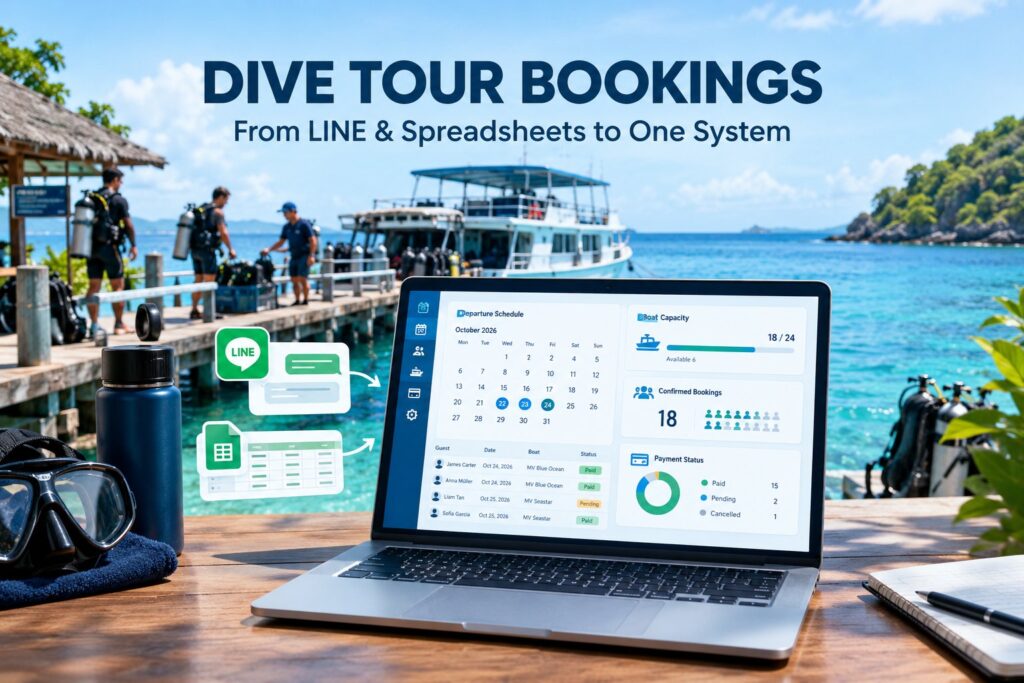
It is 7 a.m. on a high-season Monday. There are fourteen unread LINE chats, a Google Sheet with three colour-coded tabs, and a whiteboard by the boat dock. Somewhere in that pile is the fact that the 8:30 boat is two seats over capacity, and nobody has noticed yet.
This is how a large number of small dive centres, tour operators and destination management companies (DMCs) actually run. It works while the business is small and the owner remembers everything. It stops working at a predictable point, and the failures are quiet ones: a double booking, a missing deposit, a medical form nobody can find.
This post is for owners and operations managers who suspect they have reached that point. It covers what breaks first, one legal reason to take it seriously, and what any booking system, bought or built, has to get right.
Two businesses, one underlying problem
A dive centre and a DMC look different from outside. Underneath, both do the same thing: they sell limited capacity (boat seats, instructor time, tanks, vehicles, hotel rooms, guide days) to customers who arrive through many channels, and they have to turn each sale into money collected, suppliers paid and a safe, well-run day.
When that runs on chats and spreadsheets, the same three things go wrong: capacity is tracked in several places, customer information lives in chat photos and PDFs, and money is typed in more than once.
What breaks first at a dive centre
Software vendors in this space describe the same pattern, and it matches what operators report. Take the specifics with the usual caution, since the sources below sell software.
- One payment, typed three times. A deposit gets entered in the schedule, again in the cash sheet and again in the commission sheet. Each copy is a chance for the totals to disagree.
- Commission and payroll disputes. Instructor pay often mixes base pay, teaching commission, sales commission and advances. Errors are hard to see, and an instructor who finds one remembers it.
- The owner is the system. The formulas and workarounds live in one person’s head. When they are away, payroll stalls and nobody else can read the sheet.
- Problems surface at month-end. An unreconciled amount found weeks later is hard to trace.
- No honest answer to simple questions. Is equipment rental actually profitable? Which course types make money? Answering means building new formulas, so the business runs on instinct.
The last two are worth dwelling on. Not knowing your own numbers is the real cost, more than any single error.
What breaks first at a DMC or tour operator
A DMC builds multi-day packages out of hotels, transfers, activities and meals, priced by season and group size, from suppliers who each have their own rates and conditions.
- Quoting by hand. Each quote means finding the right supplier rate for the right season, adding markup, and re-doing it when the group size changes. A quote that takes hours loses to a competitor who answers the same day.
- Rates and contracts scattered across files and email threads. Nobody can say quickly which supplier rate applies to which date.
- No live view of availability. The risk is overbooking, and last-minute changes become phone calls.
- Several currencies and several payment routes, reconciled by hand.
Again, the figures that tool vendors quote ("quotes in minutes instead of hours") are marketing claims, not measured results. The problems they describe are real; the size of the saving depends on your business.
The part owners underestimate: customer health forms are sensitive data
Scuba training and many guided activities require customers to fill in health information. For recreational diver training, the standard medical questionnaire used across the industry asks the participant about their medical history. Any "yes" answer means the person must see a physician, who completes a section confirming whether there is a condition that rules out diving. A parent or guardian signs for a minor. The form is labelled confidential, but it does not say who must store it or for how long. That is left to you.
In Thailand, health data counts as sensitive personal data under the Personal Data Protection Act (PDPA). Law-firm summaries of the Act say processing it generally needs the person’s explicit consent, and that the exceptions are narrower than for ordinary personal data. They include preventing danger to someone’s life or health and establishing or defending legal claims.
Now think about where those forms live today. Photos in a LINE chat. Scans in a shared folder. A paper binder in the shop. A booking system does not make you compliant by itself, and this post is not legal advice, but a system gives you something chat photos cannot: one place to store the form, a record of the consent, and control over who can open it. If you run a business that collects health information, ask a Thai data-protection lawyer how the PDPA applies to you.
What a booking system has to get right: five things
Whether you buy a ready-made product or have one built, these five points decide whether it will help.
- One record per booking. Every channel (walk-in, chat, website, agent) ends up as one booking with one customer, one status and one payment history. If staff still ask "which sheet is it in?", the system has failed.
- Capacity as the single source of truth. Boat seats, instructors, tank fills, vehicles and guide days are counted in one place, and a booking cannot take a seat that does not exist. For a DMC this means supplier allotments and live availability.
- Forms and consent captured and stored properly. Waivers, medical statements and consent are completed by the customer, timestamped, stored with restricted access, and linked to the booking. They are not left in chat photos.
- Rates and quotes built from data. Supplier rates by season, group size and conditions sit in one place, and a quote is generated from them rather than assembled by hand.
- Money entered once. A payment is recorded one time and flows to the cash report, the commission calculation and the customer’s balance. This is what ends the payroll arguments.
A sixth point matters in this region: it should fit the way your customers actually communicate and pay. For many Thai operators that means LINE for conversation and local payment methods such as PromptPay, and for operators serving Japanese or Chinese visitors, communication in those languages. A system that expects every customer to use a web form will be bypassed by staff within a week.
Buy or build?
Ready-made products exist for both businesses. There are dive-centre management tools and tour and DMC platforms, and for a standard operation one of them is often the right answer. We would rather say so than sell you something custom you do not need.
Custom or adapted software starts to make sense when your business does not fit the standard shape: a dive centre that is also a resort with transfers and restaurants, a DMC that sells to agents in several countries with different currencies and languages, or an operator that needs bookings, forms and accounting to connect with systems you already run. In those cases the work is mostly integration, not invention.
That integration is the part Simplico does. We build and connect business systems, including ERP, booking and operations software, for manufacturers, logistics and energy clients, and the same approach applies here. We do not sell a ready-made dive or DMC product. We start by scoping what you have and telling you plainly whether you need to buy, adapt or build.
A 30-day starting plan
Week 1: list the channels. Write down every way a booking can reach you (chat apps, walk-ins, website, agents, marketplaces) and where each one gets recorded today.
Week 2: list the facts that must not be wrong. Capacity per boat or vehicle, supplier rates by season, deposit rules, cancellation terms. Put each in one place, even if it is still a spreadsheet.
Week 3: trace one booking end to end. Pick five recent bookings and follow each from first message to final payment. Count how many times each payment was typed and where each form ended up.
Week 4: decide. With the trace in hand, you can say which of the five points above hurts most, and whether a ready-made product covers it.
Talk to us
Tell us how bookings reach you today and where they go wrong, and we will tell you whether you need a product off the shelf, an adaptation or something built. A short scoping call is enough to start.
- Email: hello@simplico.net
- LINE: iiitum1984
- Phone: (+66) 97496 6397
For booking and accounting integration, see our ERP integration service. For architecture questions, see our system design and consulting service.
FAQ
We are a very small dive shop. Is this overkill?
Possibly. If you have a handful of bookings a week and one person who sees everything, a spreadsheet may be fine. The signs to watch for are the same payment entered in several places, disputes about commission, and not being able to say which course or service makes money.
Does a booking system make us compliant with the PDPA?
No. A system can give you secure storage, consent records and access control, which make good practice much easier than chat photos do. Compliance itself depends on your policies, notices and how you handle data. Ask a Thai data-protection lawyer about your own situation.
Can customers keep using LINE?
They should be able to. Good systems take the booking from wherever it starts and put it in one record. Forcing customers onto a new channel usually makes staff work around the system.
Should we buy a ready-made product or have one built?
If a ready-made product fits your business, buy it. Build or adapt when your business combines services in a way the products do not, or when bookings must connect to systems you already use.
Do you sell a dive-centre or DMC product?
No. We build and integrate custom systems, and we say so at the start of the conversation.
Sources
- Tilleke & Gibbins: Thailand, operationalising the PDPA (sensitive personal data and lawful basis)
- PADI / RSTC: Diver Medical Participant Questionnaire (medical statement form)
- ScubaCloud: Top 5 signs a dive centre has outgrown spreadsheets (vendor article)
- Softrip: Understanding DMC software (vendor article)
Latest Posts
- E-invoicing in Vietnam and Malaysia: what your POS or ERP has to do before the penalties start October 22, 2026
- CBAM for suppliers: what your EU buyer will ask you for, and the data to start collecting now October 22, 2026
- Scoping an EV Charging Platform for a Large Property Owner: Two Driver Apps, a Prepaid Wallet and Three Levels of Trust October 20, 2026
- The Site Host Problem: Giving a Condo, Hotel or Restaurant Its Own Charger Dashboard Without Another Account to Manage October 17, 2026
- Why AI Agents Stall in Southeast Asian Enterprises, and the Trust Layer That Gets Them Live October 15, 2026
- Which Product Should a Creator Promote? An Idea We Want to Test October 14, 2026