
Your best programmer has been with the shop for twenty years. The inspection procedure for that one customer lives in a PDF on a shared drive that three people know how to find. The RFQ that arrived last night is for a part that looks a lot like one you quoted two years ago, and nobody can remember what it cost to make.
This is the kind of problem a large language model (LLM) can help with. It is also the kind of problem where the obvious tool, a public AI chat service, carries a risk most shops have not thought through. Your customers’ drawings are not yours to share.
This post is for owners and managers of CNC machining and mold shops who are weighing a local LLM, one that runs on your own hardware inside your own network. It covers where it helps, where it should be kept away, and how to test it before you spend real money.
Why "local" matters to a machining or mold shop
A drawing or CAD model tells a reader a great deal: the geometry, the tolerances and a lot about how the part is made. That is why customers send them under a non-disclosure agreement (NDA), and why one manufacturing marketplace warns that generic NDA templates do not protect CAD files well. Its advice is to name the file types in the agreement and to check how files are stored, who can see them and when they are deleted.
Now apply that to AI. If a programmer pastes a customer’s drawing notes into a public chat service, that information has left your network and gone to a third party. Whether that breaks a particular NDA depends on its wording, and we are not lawyers. But the question is worth asking before the first paste, not after. We found no source that settles how public AI services should be treated under typical NDAs, so read your own contracts and ask your customers if you are unsure.
A local LLM answers the question in a simple way: the data does not leave the building. That is the main reason to run one. It is not a reason by itself to buy one, and we will say below when a cloud service is the more sensible choice.
What a local LLM is good at in a machining or mold shop
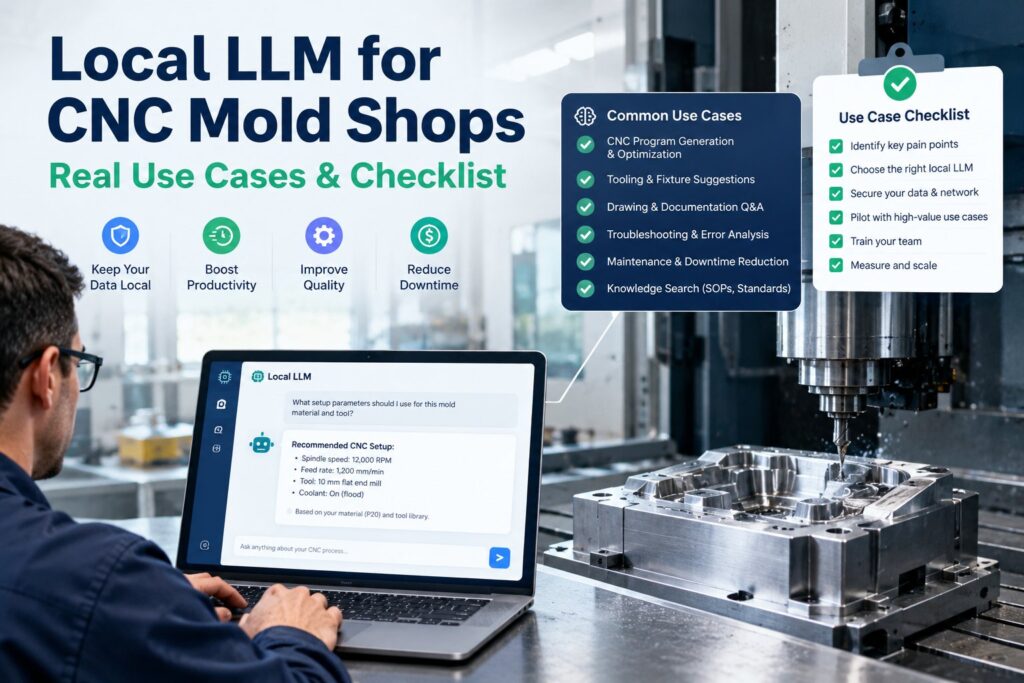
These are the jobs where a language model earns its keep. All of them are about text, not about cutting metal.
- Searching your own documents in plain language. Work instructions, inspection procedures, customer specifications, quality manuals, past non-conformance reports and tooling notes. Instead of hunting through folders, a person asks "what is the inspection frequency for customer X’s housing?" and gets an answer with a link to the source page. This is usually called retrieval-augmented generation (RAG): the model answers from your documents, not from its general memory.
- Helping with quotes. Finding past jobs with similar features, summarising what they cost and what went wrong, and drafting the reply to the customer. The estimator still decides the price.
- Translating and summarising. Customer emails, specifications and change notices that arrive in Japanese, Chinese, English or Thai and need to be understood by people who read a different one. For shops serving customers in several languages, this is often the first task people notice saving time.
- Capturing know-how. A senior machinist or programmer explains a decision, and the explanation is written down and made searchable so it survives that person’s retirement. This is a process problem as much as a technology one, but a searchable archive is what makes it useful.
- Asking questions of ERP or production data. "Which jobs for customer Y were late last quarter, and why?" in plain language, if your systems are connected.
What it should not touch
Do not use an LLM to generate G-code or toolpaths without a person checking every line. Vendors of AI programming tools describe their output as a starting point that still needs review. One vendor guide puts the output at roughly 80% complete, which is the vendor’s own claim, not a measured result. One small academic study we found tested an AI model checking G-code against a machine’s control-panel screenshot on 16 test cases. Accuracy on the combined G-code and panel check ranged from about 63% to 75% depending on the prompt set-up, and the authors say the results are preliminary and specific to one lathe. That is a research result on a very small sample, but it points the right way: do not hand a machine’s motion to a text predictor.
The same goes for anything where a wrong answer can crash a tool or hurt someone: feeds and speeds taken as fact, safety procedures, and tolerances read off a drawing. A language model can be useful as a reader of documents. It is not a measuring instrument.
CAM-specific AI products exist, and they are a separate category from a general LLM. They work inside CAM software and use your tool library. If programming time is your bottleneck, look at those on their own merits, and measure the result yourself.
What it takes to run one
You do not need a data centre. As a rough guide from one hardware explainer, a model’s weights take about 2 GB of memory per billion parameters at full 16-bit precision, and about 0.6 GB per billion when compressed ("quantised") to 4 bits. On that basis, a mid-sized model of around 30 billion parameters, quantised, needs roughly 20 GB just for the weights, and more for the conversation context and several users at once. A 70-billion-parameter model quantised to 4 bits needs more than 40 GB.
Two practical points follow. First, size the hardware for how many people will use it at the same time and how long their documents are, not just for the model. Second, a smaller local model is weaker than the large cloud models people compare it to. For document search with citations that is usually acceptable, because the answer comes from your pages. For open-ended reasoning, expect less.
When a cloud service is the better answer
If the documents you want to search are not confidential (public standards, your own marketing material, generic training content), a cloud service may be simpler and cheaper. A local system also needs someone to maintain it. We would rather tell you this than sell you hardware you do not need. Choose local when the data is covered by NDAs, when your customers expect it, or when you would otherwise be tempted to paste restricted material into a public tool.
Five questions to test before you buy anything
Take twenty real questions from the last month, ones your staff actually asked or struggled to answer, and use them as the test.
- Does it answer from your documents and show the source page? An answer with no citation cannot be trusted or checked.
- Does it say "I don’t know" when the answer is not in the documents? A system that invents an answer is worse than no system.
- Does it handle the languages you work in, including customer terms in Japanese, Chinese or Thai?
- Who can see which documents? Customer A’s drawings should not appear in an answer to someone working on customer B’s job.
- Can someone in your shop maintain it? Or is there a support plan you can afford?
A 30-day starting plan
Week 1: choose one document set. Pick a single collection that people search for often and that you are free to use, such as inspection procedures or work instructions. One use case, as the CAM vendors’ own guide also advises.
Week 2: check the contracts. Read the NDAs for the customers whose documents are involved. Note any limits on third-party processing or storage.
Week 3: write the test questions. Collect the twenty questions and the correct answers, with the page each answer comes from.
Week 4: run the test and count. How many answers were right, how many had the right source, how many were confidently wrong? That number tells you whether to go further.
Where Simplico fits
We build and run on-premise LLM systems for companies that cannot send their data to a public service: a stack installed inside your network, with search over your own documents, guardrails and an audit log, connected to your ERP or production systems where that helps. Our own service page describes a scoped proof of concept in roughly two to three weeks. We make no certification claims, and we do not promise that a language model replaces any part of your engineering.
If you want to know whether you are ready before talking to anyone, our free local LLM readiness assessment is a 25-question self-check covering compliance, infrastructure, use cases, integration and organisation. Details of the service are on the simpliLLM page.
Talk to us
Tell us which documents your team searches for most and what your customers’ NDAs say, and we will tell you whether a local LLM is a good fit or whether something simpler will do. A short scoping call is enough to start.
- Email: hello@simplico.net
- LINE: iiitum1984
- Phone: (+66) 97496 6397
FAQ
Can a local LLM write G-code for us?
It can produce text that looks like G-code, but it should not be used to run a machine without a qualified person checking every line. Published evidence on reliability is thin, and vendors of AI programming tools describe their output as needing review.
Is it safe to paste customer drawing notes into a public AI chat?
That depends on your NDA and on the service’s terms. Many shops have not checked. Read the contracts, and ask your customer if the wording is unclear. A local system avoids the question because the data stays inside your network.
How big a computer do we need?
It depends on the model size, how many people use it at once, and how long their documents are. As a rough guide, a mid-sized quantised model needs on the order of 20 GB of GPU memory for the weights alone. Plan from your use case, not from a model name.
Will it replace our estimators or programmers?
No. It speeds up finding information and drafting text. Judgement about price, process and safety stays with your people.
We only have a few machines. Is this worth it?
Probably not yet, unless you hold a lot of customer documents under NDA and your staff already waste time searching. Start with the 30-day test above before spending anything.
Sources
- MakerVerse: NDA and IP protection for CAD files (marketplace article)
- CloudNC: How to use AI in machining (vendor article)
- arXiv: Few-shot VLM-based G-code and HMI verification in CNC machining (preprint, small dataset)
- Computing for Geeks: How much VRAM to run an LLM (hardware guide)
Latest Posts
- Dive centres and tour operators: when LINE chats and spreadsheets stop working as your booking system October 24, 2026
- E-invoicing in Vietnam and Malaysia: what your POS or ERP has to do before the penalties start October 22, 2026
- CBAM for suppliers: what your EU buyer will ask you for, and the data to start collecting now October 22, 2026
- Scoping an EV Charging Platform for a Large Property Owner: Two Driver Apps, a Prepaid Wallet and Three Levels of Trust October 20, 2026
- The Site Host Problem: Giving a Condo, Hotel or Restaurant Its Own Charger Dashboard Without Another Account to Manage October 17, 2026
- Which Product Should a Creator Promote? An Idea We Want to Test October 14, 2026