
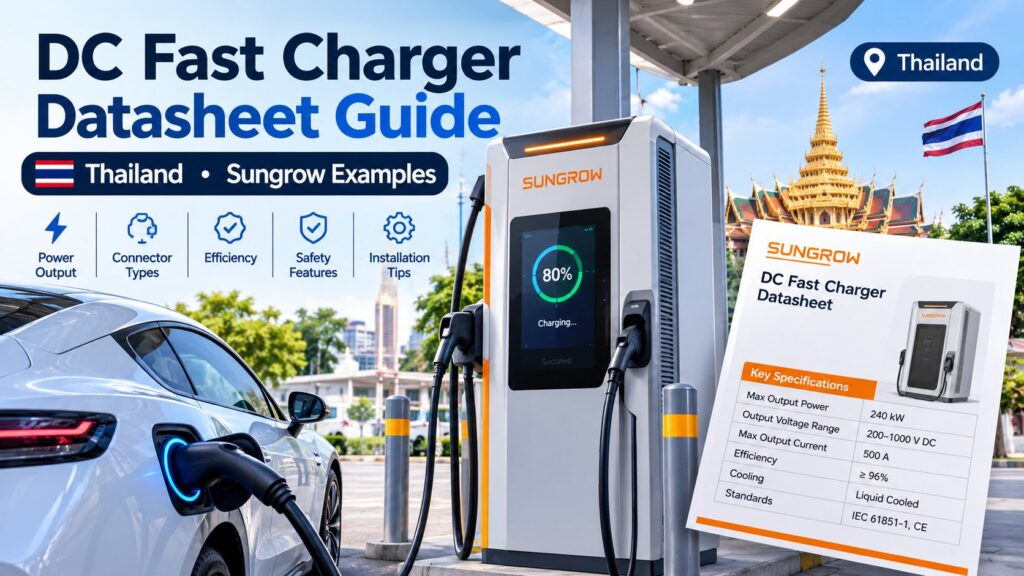
Choosing a DC fast charger is one decision. Running it is another. For an EV charging operator, a charger on its own is half a business. The other half is getting it online, getting drivers to pay, getting a site host to see their numbers, and getting someone to answer when it fails at night. That second half is what we do.
This post does two things. It uses five Sungrow DC chargers as worked examples of how to read a datasheet, in plain terms and with the numbers from Sungrow’s own datasheets. We picked them because they run from a wall-mountable 50 kW-class unit to a megawatt platform. They are examples, not a recommendation or a price list. And it explains where our software and services start, which is the same whichever brand you buy. One boundary first: everything about the chargers below comes from the datasheets, not from our own test bench. Two of the five are marked "Preliminary" by Sungrow, so confirm current specifications, availability and Thai pricing with Sungrow or its Thai channel before you design around them.
Five example chargers at a glance
| IDC80E | CDC120/160E | IDC180E | IDC480E | CDC1000E | |
|---|---|---|---|---|---|
| Datasheet status | V2 | V6, Preliminary | V4 | V10 | V4, Preliminary |
| Rated power | 49.9 / 60 / 80 kW | 120 / 160 kW | 60 / 120 / 150 / 180 kW | 240 / 360 / 480 kW cabinets | 1,000 kW cabinet (500 kW x 2) |
| Vehicles served | 2 | 2 | 2 | Up to 8 | Up to 12 |
| Output voltage | 150-1000 V DC | 150-1000 V DC | 200-1000 V DC | 200-1000 V DC | 150-1000 V DC |
| Peak efficiency | 97% | 96.3% | 96.5% | 96.5% | 97.0% |
| Enclosure | IP65, C5 | IP55 | IP65, C5 | IP65, C5 | IP55 |
| Operating temperature | -30 to 60 °C, derating over 50 °C | -30 to 55 °C, derating over 50 °C | -35 to 55 °C | -35 to 55 °C | -35 to 55 °C |
| Charger-to-CSMS protocol | OCPP 1.6J, 2.0.1 coming soon | OCPP 1.6J, 2.0.1 coming soon | OCPP 1.6J, ready for 2.0.1 | OCPP 1.6J, 2.0.1 coming soon | OCPP 1.6J, 2.0.1 coming soon |
| Thai grid certification listed | PEA | PEA, NBTC | PEA | PEA | Not listed (CE, CB) |
| Standard warranty | 3 years | 3 years | 3 years | 3 years | 3 years |
All five use CCS2 connectors for cars. The CDC1000E also offers an MCS connector for heavy trucks.
Which one fits which site
IDC80E (49.9 / 60 / 80 kW): the small-footprint option. At 660 x 1050 x 390 mm and up to 160 kg, it can be mounted on a pedestal, on a wall, or on a trolley. Two CCS2 outlets share the power: 80 kW to one car or 40 kW to each of two. That suits a hotel, a condo car park, a retail site or a workplace where space is tight and nobody needs a 180 kW session. Sungrow’s datasheet carries an "available in June" note, so ask about current availability.
CDC120/160E (120 / 160 kW): the mid-range workhorse. Two CCS2 ports, with each port able to reach up to 160 kW according to the datasheet. It is floor-mounted, rated IP55, and has a smart forced-air cooling system rated at 65 dB(A) or less. It is a natural fit for a supermarket, a mall or a petrol-station forecourt adding fast charging. This is a Preliminary datasheet, so treat the figures as subject to change.
IDC180E (60 to 180 kW): the public fast-charging unit. One cabinet, two CCS2 outlets, configurable at power-module level, so 180 kW to one car or 90 kW to each of two. IP65 and C5 anti-corrosion, an integrated MID-certified meter, and an optional Eichrecht/PTB-certified meter. This is the one that lists OCPP 2.0.1 as "ready" rather than "coming soon".
IDC480E (240 / 360 / 480 kW): the hub. A power cabinet feeds separate dispensers, so one cabinet can serve up to eight vehicles, with dynamic power allocation in 30 kW steps. Dispensers come air-cooled at 240 kW (dual cable) or 480 kW (single cable), or liquid-cooled at 480 kW. This is for highway rest stops, large forecourts and fleet depots where you want many bays sharing one grid connection.
CDC1000E (ChargeStack 1000): the heavy-duty platform. A 1,000 kW cabinet that supports up to 12 outputs, and several cabinets can be paralleled to 3,500 kW. Dispensers include dual-CCS2 and a CCS2 plus MCS version for trucks. The datasheet is Preliminary and lists CE and CB but not PEA, so this is a conversation about a specific project, not a catalogue purchase.
What the datasheets tell an operator in Thailand
Four points are worth reading closely.
Heat. Every unit lists an operating ceiling of 55 °C (60 °C for the IDC80E), but the IDC80E and CDC120/160E state derating above 50 °C ambient. A forecourt in direct afternoon sun is not the same as a shaded car park. Ask how ambient temperature is measured at your site before you assume full power in the hot season.
Grid certification. Four of the five datasheets list PEA among their certifications. PEA is the Provincial Electricity Authority, which distributes power outside Bangkok; the Bangkok area is served by a different utility, and none of these datasheets lists it. A line on a datasheet is not an approval for your site. Your connection still goes through the utility that serves your address.
Metering. The IDC180E has an integrated MID meter; the IDC80E, IDC480E and CDC1000E list MID/PTB meter support. If you plan to bill by the kWh and need the meter to be certified, check which meter is in the exact configuration you are buying.
Power sharing. Most of these units split power dynamically between outlets, and the datasheets say compatibility with PV and battery storage is "reserved". Reserved means a path exists. It does not mean it is switched on, so ask what is available today.
Where our software starts: the OCPP link
Every one of these chargers lists the same thing in the communication section: OCPP 1.6J as the protocol between the charger and a charging station management system (CSMS). Four add "OCPP 2.0.1 coming soon" and one says "ready for OCPP 2.0.1".
That one line is where our work begins. The charger is the hardware. The CSMS is the system that knows who is allowed to charge, what the price is, whether the session was paid, and which sites the head office should see.
flowchart TD
    A["DC charger"] --> B["OCPP 1.6J over secure WebSocket"]
    B --> C["Simplico CSMS"]
    C --> D["Operator dashboard"]
    C --> E["Driver QR scan to charge"]
    C --> F["Site host Owner App"]
    C --> G["OCPI roaming"]
    E --> H["PromptPay and Thai payments"]
Our production platform speaks OCPP 1.6J today. OCPP 2.0.1 is available as an add-on for new deployments, so a charger that moves to 2.0.1 later does not mean a new CSMS.
What our services cover
Here is the split between what runs today and what is project work.
Already running on our platform:
- An OCPP 1.6J engine with remote start and stop, smart charging and firmware update commands.
- A white-label operator dashboard with your branding and your own domain.
- Driver scan-to-charge by QR code, with Thai payment options including PromptPay and QR30, and an optional branded mobile app.
- Real-time monitoring and client dashboards.
- A host view for condos, hotels and restaurants that own the site but not the platform, as described in The Site Host Problem.
- OCPI roaming so drivers on partner networks can use your chargers.
- Managed hosting, including backups and monitoring.
- ERP and property-management integration as an add-on.
What we do around any charger order, as project work:
- Scoping. Which model, how many bays, and how much grid capacity you really have. For a many-site owner, see how we broke this down in Scoping an EV Charging Platform for a Large Property Owner.
- Connecting and commissioning. Pointing each charger at the CSMS, checking that it authenticates and reports status, and running test sessions before you open to the public.
- Pricing and payment set-up. Tariffs, idle or parking fees, revenue shares with site hosts, and VAT reporting.
- Hand-over. Staff training, and a support route when something fails.
One honest limit: our platform is built to work with any charger that speaks OCPP 1.6J, and all five of these do. That is a protocol statement, not a promise that every model has already been run end to end on our servers. The first commissioning of each model is where we confirm it, and we will tell you if a model needs anything special.
Eight questions before you choose a model
- How many cars should be charging at once at the busiest hour, and how much power is each car likely to accept?
- How much grid capacity does the site really have, and which utility serves the address?
- What is the hottest, sunniest spot where the charger will stand, and is there shade?
- Do you need a certified meter for kWh billing?
- Which backend will the charger connect to, and who sets that up at commissioning?
- Who is the site host, and what should they see?
- Which payment methods do your drivers expect: PromptPay, card, RFID, or all three?
- What happens at 2 a.m. when a charger goes offline, and who is paid to answer?
If you want to work through these for a real site, send your site type, number of bays, target power per bay and grid capacity to hello@simplico.net with the subject "DC charger scoping". We will reply with a scoped outline within 48 hours. You can also reach us on LINE at iiitum1984.
FAQ
Are you recommending Sungrow chargers?
No. The five models are examples of how to read a datasheet. The same questions apply to any brand.
Can you help if I have already chosen a different brand?
Yes. Any charger that supports OCPP 1.6J can connect to our platform, and we confirm each model at its first commissioning.
Do these chargers work with your CSMS?
All five list OCPP 1.6J, which our production platform speaks. We confirm each model at its first commissioning.
Do I have to use Sungrow’s own management platform?
The datasheets mention firmware updates through Sungrow’s iEnergyCharge. Which backend your chargers connect to for day-to-day operations is a decision to make before you order. Ask us and Sungrow how it is configured.
Is OCPP 2.0.1 supported?
The datasheets say "coming soon" for four models and "ready" for the IDC180E. On our side, OCPP 2.0.1 is available as an add-on for new deployments, and it adds features such as Plug & Charge.
Which model should I choose for a condo?
Usually the smallest unit that meets your busiest-hour demand, so the IDC80E or CDC120/160E. The answer depends on grid capacity and on whether residents or the public use it. Send us the details.
Do the CDC120/160E and CDC1000E have final specifications?
Their datasheets are marked Preliminary. Confirm the final figures before you commit.
Who is behind this?
Simplico, a software engineering studio based in Thailand. We build and operate EV charging platforms for operators across Thailand and Southeast Asia.
Related Posts
- Scoping an EV Charging Platform for a Large Property Owner: Two Driver Apps, a Prepaid Wallet and Three Levels of Trust
- The Site Host Problem: Giving a Condo, Hotel or Restaurant Its Own Charger Dashboard Without Another Account to Manage
- Simplico EV charging platform (CSMS)
Latest Posts
- Is Your Company Ready for AI Agents? A 20-Question Checklist on Approval, Permissions and Audit Trails November 4, 2026
- Supermarket Fridges Hit 50°C: What the European Cold-Chain Cyberattacks Mean for Your Business November 4, 2026
- Attackers Now Use AI Tools Too: A 10-Point Checklist for Vetting the AI Tools Your Team Uses November 1, 2026
- PHP2Shell Won’t Be the Last: What a SOC Needs Ready Before the Next AI-Found Zero-Day October 28, 2026
- AI Is Rewriting ERP Development: 7 Shifts Every ERP Owner Should Know in 2026 October 27, 2026
- Local LLM or Cloud API? What Hardware to Buy in Late 2026, and When to Make the Switch October 27, 2026