
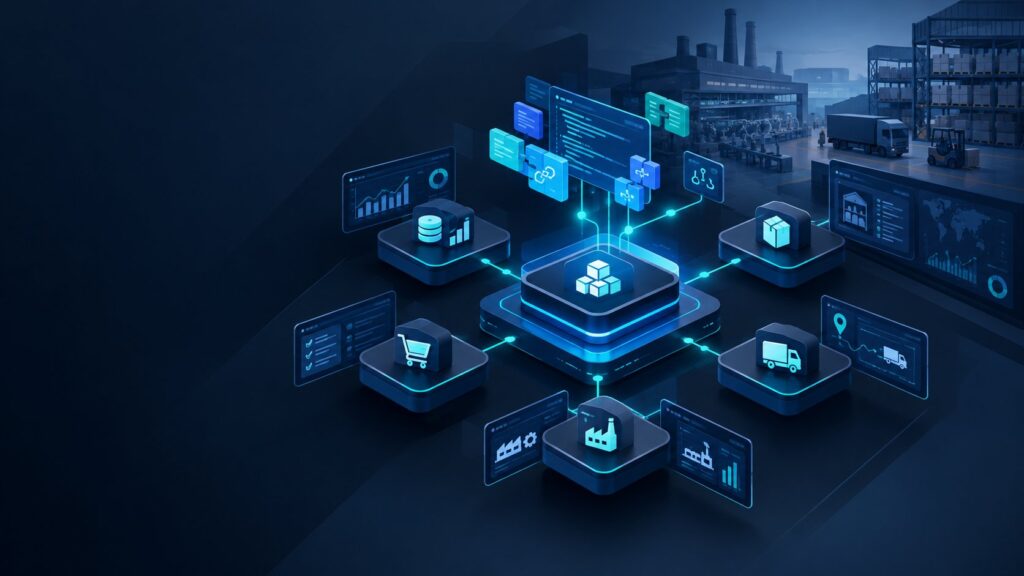
Two years ago, "AI in ERP" meant a chatbot bolted onto a dashboard. In 2026 the change is deeper, and it hits three places at once: how ERP software is built, what an ERP can do, and how it connects to the rest of your business.
If you run Odoo, ERPNext, SAP, or a custom system, these seven shifts decide where your next budget should go. At the end there is a 10-question readiness checklist you can run with your own team this week.
Shift 1: Writing code gets cheap. Reviewing it gets expensive.
AI coding assistants are now good at the repetitive parts of ERP work: CRUD modules, report layouts, data-migration scripts, test scaffolding, and documentation. A custom module that once took weeks can often be prototyped in days.
But ERP code is not ordinary code. A small mistake in tax calculation, inventory costing, or currency rounding does not crash the app. It quietly posts wrong numbers. So the bottleneck moves from typing to review and testing by someone who understands the accounting.
The practical rule: let AI draft, but require domain-aware tests for anything that touches money, stock valuation, or tax.
Shift 2: Legacy ERP code becomes readable
Almost every company has an ERP corner nobody wants to touch: old stored procedures, heavily customized modules, or an upgrade that was postponed for years. AI can read that code, explain what it does, and propose a refactor. That lowers the cost of upgrades and migrations, which used to be the most feared line item in ERP projects.
A caution: an AI explanation of old code is a hypothesis, not a fact. Confirm it against real transactions in a test environment before you rely on it.
Shift 3: Users ask questions instead of building reports
Natural-language access is the most visible change. Instead of waiting for a custom report, a manager asks for overdue invoices by customer group this quarter and gets an answer.
The safe design is important here. The AI should translate the question into a deterministic query against the ERP and show its work, not "recall" numbers from memory. When money is involved, a confident wrong figure is worse than no answer.
Shift 4: Document-heavy work gets automated first
Invoices, purchase orders, delivery notes, customs forms, bank statements. This is where most ERP teams lose hours every week, and where AI delivers the clearest return today: extracting fields, matching documents against orders and receipts, and flagging exceptions for a human.
Retrieval over your own documents (SOPs, contracts, manuals) also lets staff get answers grounded in company material rather than the open internet.
Shift 5: Agents do not just answer, they act
This is the biggest change, and the one that needs the most care.
An agent can draft a purchase order, spot a mismatch, and route an approval, instead of only answering a question. The enabling piece is a standard way for agents to call ERP functions. The Model Context Protocol (MCP) is becoming that standard.
According to a July 2026 write-up from Tarento, SAP announced broad MCP support at TechEd 2025, shipped MCP support in SAP HANA Cloud in early 2026, and announced a partnership to run Claude inside its Joule assistant using MCP. The same write-up argues that ERP platforms were designed with a human in the loop, so they need an agent-friendly layer: clear APIs, a shared business vocabulary, and policy enforced at the point of action. You can read it at Tarento’s agent-ready ERP blueprint.
The pattern that keeps this safe looks like this:
flowchart TD
    A["AI agent"] --> B["Tool layer with permissions"]
    B --> C["Approval step for risky actions"]
    C --> D["ERP core"]
    B --> E["Audit log"]
    C --> E
    D --> E
The agent never touches the ERP core directly. A tool layer checks permissions, risky actions wait for a human, and everything is logged.
Shift 6: Data quality becomes the limiting factor
AI on top of messy master data gives confident wrong answers. Duplicate customers, inconsistent product codes, and unit-of-measure chaos were always a nuisance. With AI they become the main reason pilots fail. Expect cleanup and governance work to grow, not shrink.
Shift 7: Governance moves from "nice to have" to "required"
When software can change records, you need to answer four questions after the fact: what did it see, what did it decide, what did it change, and who approved it? Design for that from day one:
- The agent inherits the user’s permissions, never blanket admin access.
- Every action is logged, with the input and the reasoning.
- Sensitive actions require human approval, and autonomy is raised gradually per action type.
- Personal data handling follows the rules that apply to you (see the market notes in the localized versions of this post).
What does not change
Vendors in this space tend to be optimistic, so here is the sober part. DeployMonkey, an Odoo hosting vendor, publishes predictions for 2026 to 2030 and is explicit that AI will not eliminate ERP consultants or all customization. It also says business process design, tax and compliance review, and data quality remain human responsibilities. We agree. Unique business rules still need custom development. AI makes that development faster, not unnecessary.
The 10-question ERP AI-readiness checklist
Answer yes or no. Every "no" is a place to start.
- Do you have a documented API (or stable export) for your core ERP data?
- Are customers, suppliers, and products free of duplicates, with one master record each?
- Can you list which users and roles can approve what, today?
- Do you have a test environment that mirrors production closely enough to trial changes?
- Are your tax, costing, and rounding rules covered by automated tests?
- Do you know which documents (invoices, POs, delivery notes) consume the most manual hours?
- Is there a log of who changed what in the ERP, and can you search it?
- Do you know where personal data lives in the ERP and who may see it?
- Has someone decided which actions an AI may never take without approval?
- Do you have one measurable baseline (for example, minutes per invoice) to compare against after a pilot?
Scoring: 8 to 10 yes means you can pilot an AI workflow now. 4 to 7 means fix data and permissions first. Under 4 means start with data cleanup and access control; a pilot now would mostly produce noise.
What this means for ERP developers
Pure "build custom screens and reports" work is becoming commoditized. The durable value sits in integration, data modeling, domain-specific workflows, and building the safe layer between AI and the ERP. That favors teams who know both the business process and the engineering.
Frequently asked questions
Will AI replace ERP developers?
It replaces some repetitive coding tasks, not the need for people who understand accounting rules, integrations, and risk. The work shifts toward review, design, and governance.
Is it safe to let an AI agent post transactions in my ERP?
Only with limits. Use the user’s permissions, require approval for sensitive actions, log everything, and test in a non-production copy first. Start with read-only or draft-only tasks.
Which ERP is best for AI?
Platforms with complete APIs and well-documented customization are easier to connect, which is why open platforms such as Odoo and ERPNext are popular for AI projects. The best choice still depends on your processes and your team, not on AI alone.
Where should a company start?
Pick one high-volume, document-heavy process (such as invoice matching), measure the current time, and pilot with a human approving every result.
Does Simplico offer this as a packaged product?
Not as a single packaged product. We customize Odoo and ERPNext and build document AI and retrieval applications, and we scope AI-to-ERP integrations per project with the permission and approval design described above.
Talk to us
If you want a second opinion on your ERP and AI plans, email hello@simplico.net with your ERP platform and the process you want to improve. We will review your answers to the checklist above and tell you honestly where AI will help and where it will not.
Sources: Tarento, DeployMonkey.
Latest Posts
- Why a Farmer’s Price Is Never Recalculated: Price Snapshotting and FIFO in Depot Software October 26, 2026
- One Verdict From Five Readings: Multi-Point Measurement and Foot-Pedal Capture on the Inspection Bench October 26, 2026
- What an EV Charger Does When the Internet Drops: OCPP 1.6J Offline Behaviour and Where a Local CSMS Proxy Fits October 26, 2026
- Founding Partners Wanted: A White-Label E-Commerce Platform with Thai Payments and Made-to-Order Products October 26, 2026
- Founding Partners Wanted: An On-Premise MES That Connects ERP Orders, Operators and Machines October 25, 2026
- Founding Partners Wanted: A Depot Operations Platform for Scrap Recycling Yards October 25, 2026