
The email usually arrives from a purchasing contact in Europe. It is polite, short, and contains a phrase you have not seen before: "Please provide installation-level embedded emissions for the products you supply to us."
If you make steel, aluminium, fertiliser, cement or fabricated products and you sell to the EU, directly or through a larger supplier, that email is a CBAM request. You do not need to become a carbon expert to answer it. You do need to know what is being asked, why it matters to your buyer’s costs, and which records to start gathering this month.
What CBAM is, in four sentences
The EU’s Carbon Border Adjustment Mechanism (CBAM) makes importers pay for the carbon emitted in making certain goods outside the EU. The covered goods are cement, iron and steel, aluminium, fertilisers, hydrogen and electricity. The legal duty sits with the EU importer (the "authorised CBAM declarant"), but the emissions data has to come from you, the producer.
The definitive period began on 1 January 2026. The first annual declaration, covering 2026 imports, is due by 30 September 2027, and CBAM certificates go on sale from 1 February 2027.
One note on scope: importers bringing in less than 50 tonnes a year of steel, aluminium, cement and fertiliser combined are exempt. If your only EU customer is very small, they may never ask you for anything. If your buyer is larger, or buys through a larger importer, they will.
Why this lands on suppliers: the default-value penalty
An importer can declare emissions in one of two ways: using verified, installation-specific data from the producer, or using default values published by the European Commission for each country and product.
Default values are set conservatively, and they carry a mark-up on top. For steel, aluminium and cement the mark-up is 10% for 2026 imports, 20% for 2027 and 30% from 2028. Fertilisers follow a different, much smaller mark-up.
In plain terms: if you cannot supply verified data, your buyer calculates your product’s carbon cost from a national average plus a penalty. A competitor who can prove lower emissions makes the same product cheaper to import. Production routes differ a lot here. Steel made in an electric arc furnace from scrap and steel made in a blast furnace have very different emissions per tonne, and the default value does not know which one you run.
To keep this in proportion: the share of embedded emissions that importers actually pay for is being phased in, starting at 2.5% for 2026 and rising towards 100% by 2034 as the EU withdraws free allocation for its own producers. The 2026 bill is small. The reasons to start now are different: buyers are already collecting data, verification takes time to arrange, and the cost of having no data grows every year.
The data gap cascades down the chain
Embedded emissions include the emissions of the materials that go into a product (the Regulation calls them precursors). That means a request to a tier-1 supplier usually becomes a request to its own suppliers, and then to theirs. Small producers at tier-2 and tier-3 often receive the request last, with the shortest notice and no system to answer it.
What good data looks like: the five things to collect
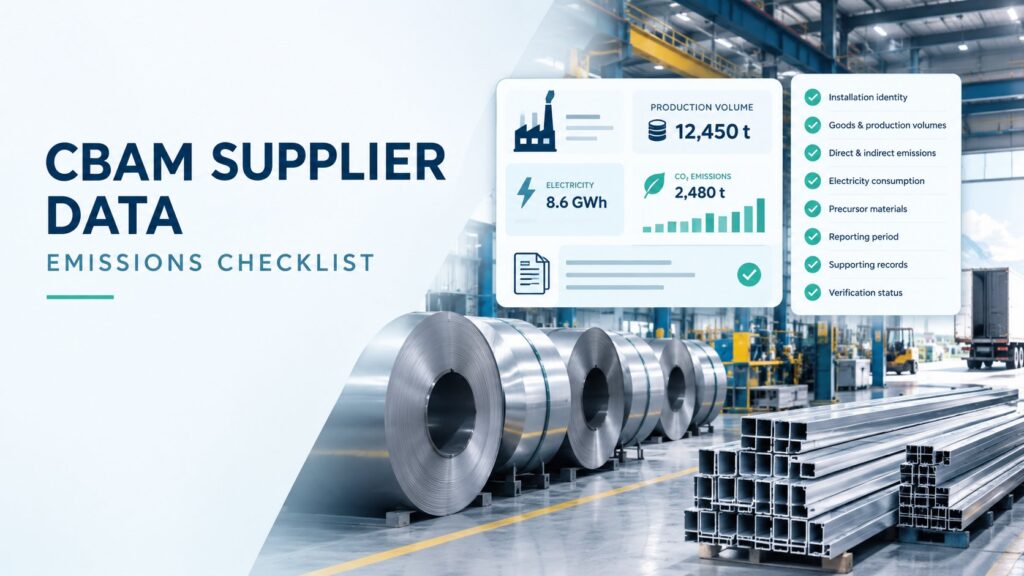
Your EU buyer needs installation-level data, and an independent verifier will eventually need to check it. These five items cover most of what is asked.
- Installation and production-route map. Which site makes which product, and by which process. One page, drawn once, kept current.
- Monthly inputs per installation. Electricity (kWh and source), fuels, raw materials, and the scrap share where relevant. Twelve months of history is the target.
- Outputs per product. Tonnes produced and sold, by product code (the customs "CN code" your buyer uses).
- A calculation of specific embedded emissions per tonne of product, with the method written down. The method matters as much as the number, because the verifier checks how you got there.
- An evidence trail. Invoices, meter readings, supplier declarations and production logs, stored so that someone outside your company can follow each figure back to its source.
Where the importer wants to use your actual data instead of defaults, that data must be verified by an independent verifier accredited under the EU framework. Records that are only ever kept in a spreadsheet nobody else can follow will not survive that review. The Commission has also opened a registry portal for non-EU producers (called O3CI) where verified installation data can be shared with every EU importer who buys from you, instead of answering each buyer separately. Registration needs an EU Login account with two-factor authentication, a company registration certificate, and proof of who represents the company.
A 30-day starting plan for a small supplier
Week 1: find out what is in scope. List your products against the CBAM goods and their CN codes. Ask each EU customer what they need and by when, and ask who their CBAM declarant is.
Week 2: map and gather. Draw the installation and production-route map. Collect twelve months of electricity, fuel and material records for each site.
Week 3: first-pass calculation. Work out an emissions figure per tonne for each in-scope product, and write down every gap: a meter you do not have, a supplier who has not given you data, a month with no invoice.
Week 4: decide and plan. Decide what to automate and what stays manual. Talk to a verifier early, even informally, so you know what they will expect to see before you build the process.
Common mistakes
- Treating a voluntary carbon footprint as CBAM data. A footprint built to another standard is not automatically accepted. CBAM has its own methodology and its own verification rules.
- Keeping data in a separate spreadsheet for each site, with nobody responsible for the whole picture.
- Waiting for the buyer’s questionnaire instead of preparing first. The questionnaire arrives with a deadline attached.
- Collecting only totals. A plant-level electricity bill is not a per-product figure. You need to be able to split inputs and outputs by product.
Where software helps
Most of this work is not carbon science. It is data plumbing: pulling monthly energy and production figures out of the systems you already use (ERP, production records, meters), calculating a per-product figure the same way every time, and keeping the evidence attached to the number.
That is the part Simplico builds. We have spent years connecting ERP, production and measurement systems for manufacturers, and the same data layer can produce the data pack an EU buyer or verifier asks for. If your records already live in an ERP, our ERP integration work is a natural starting point. We are not selling a ready-made CBAM product; we scope what you have first and tell you honestly what is missing.
Talk to us
Tell us what records you already have and we will tell you what is missing. A short scoping call is enough to start.
- Email: hello@simplico.net
- LINE: iiitum1984
- Phone: (+66) 97496 6397
For architecture and integration questions beyond ERP, see our system design and consulting service.
FAQ
Is my company affected if I do not export to the EU directly?
Possibly. If you supply a company that exports covered products to the EU, or a tier-1 that does, your data may be requested through that chain.
What if my EU buyer imports less than 50 tonnes a year?
Importers below the 50-tonne annual threshold are exempt, so they may not need your data. The threshold counts all covered steel, aluminium, cement and fertiliser together, and it is the importer’s total, not yours.
Do I have to use verified data?
No. The importer can use default values instead. But defaults carry a mark-up that rises over time, so verified data is how a supplier with lower emissions shows it and avoids being priced at the national average.
Can a carbon price paid in my own country be deducted?
The importer can deduct a carbon price that was effectively paid in a third country, with documentation. Whether this applies to you depends on your country’s rules, so check with your buyer’s adviser.
Is a CBAM calculation the same as an ISO carbon footprint?
No. CBAM defines its own methodology for embedded emissions and requires accredited verification when actual data is used. A footprint prepared for another purpose may be a useful starting point, but it is not a substitute.
Sources
- European Commission: CBAM Registry, including the portal for non-EU installation operators and verifiers
- European Commission: Verification of CBAM emissions
- European Commission: CBAM legislation and guidance
- European Commission: Officially published simplifications for CBAM (Regulation (EU) 2025/2083)
Regulation references: Regulation (EU) 2023/956 (CBAM), amended by Regulation (EU) 2025/2083; default values and mark-ups in Implementing Regulation (EU) 2025/2621; verifier accreditation in Delegated Regulation (EU) 2025/2551.
Latest Posts
- E-invoicing in Vietnam and Malaysia: what your POS or ERP has to do before the penalties start October 22, 2026
- Scoping an EV Charging Platform for a Large Property Owner: Two Driver Apps, a Prepaid Wallet and Three Levels of Trust October 20, 2026
- The Site Host Problem: Giving a Condo, Hotel or Restaurant Its Own Charger Dashboard Without Another Account to Manage October 17, 2026
- Why AI Agents Stall in Southeast Asian Enterprises, and the Trust Layer That Gets Them Live October 15, 2026
- Which Product Should a Creator Promote? An Idea We Want to Test October 14, 2026
- A Local LLM in a Factory, With Nothing Leaving the Building October 13, 2026